
Seventh Sunday After Pentecost - 7/19/26
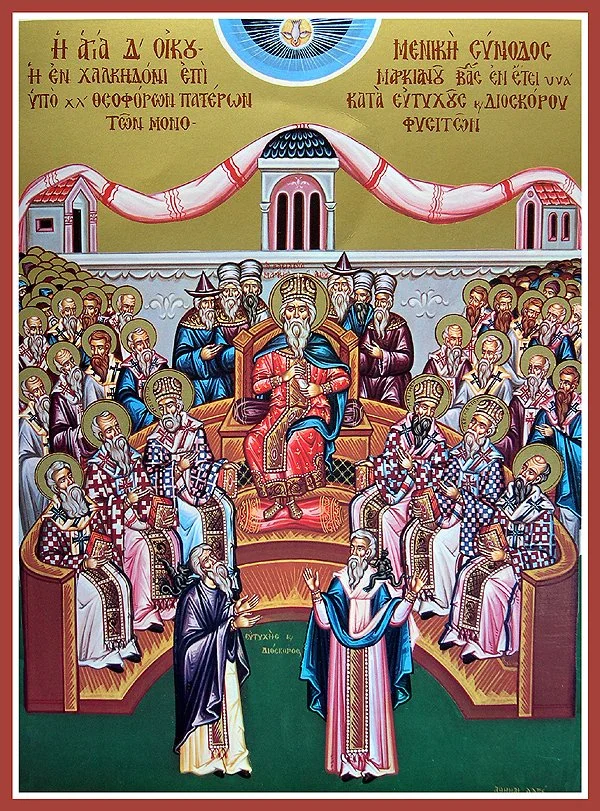
Sunday, July 19th, is the seventh Sunday after Pentecost.
On this day, we remember the fathers of the first six ecumenical councils. The fact that the Seventh Ecumenical Council (Nicea II) is not commemorated today testifies to the antiquity of today’s celebration. (The Seventh Council, commemorated on the Sunday nearest to October 11, was not convened until the year 787 at Nicea against the Iconoclast heresy.)
The Church venerates the Holy Fathers of the Ecumenical Councils because Christ has established them as “lights upon the earth,” guiding us to the true Faith. “Clad in the garment of truth,” the doctrine of the Fathers, based upon the preaching of the Apostles, has established one faith for the Church. The Ecumenical Councils, are the highest authority in the Church. Such Councils, guided by the grace of the Holy Spirit, and accepted by the Church, are infallible.
On this day, we also remember:
The Uncovering of the Relics of Ven. Seraphim of Sarov (1903).
St. Theodore of Edessa, Mesopotamia (848)
Ven. Macrina, sister of St. Basil the Great (380)
Ven. Dius, Abbot, of Antioch (ca. 430)
Rt. Blv. Román, Prince of Riazan’ (1270)
Ven. Paísii of the Kiev Caves (Far Caves—14th c.)
Bl. Stephen (1427), King of Serbia, and his mother, St. Militsa (1405).
Readings for Sunday, July 19th:
-
7
Remember those who rule over you, who have spoken the word of God to you, whose faith follow, considering the outcome of their conduct.
8
Jesus Christ is the same yesterday, today, and forever.
9
Do not be carried about with various and strange doctrines. For it is good that the heart be established by grace, not with foods which have not profited those who have been occupied with them.
10
We have an altar from which those who serve the tabernacle have no right to eat.
11
For the bodies of those animals, whose blood is brought into the sanctuary by the high priest for sin, are burned outside the camp.
12
Therefore Jesus also, that He might sanctify the people with His own blood, suffered outside the gate.
13
Therefore let us go forth to Him, outside the camp, bearing His reproach.
14
For here we have no continuing city, but we seek the one to come.
15
Therefore by Him let us continually offer the sacrifice of praise to God, that is, the fruit of our lips, giving thanks to His name.
16
But do not forget to do good and to share, for with such sacrifices God is well pleased.
-
1
Jesus spoke these words, lifted up His eyes to heaven, and said: “Father, the hour has come. Glorify Your Son, that Your Son also may glorify You,
2
as You have given Him authority over all flesh, that He should give eternal life to as many as You have given Him.
3
And this is eternal life, that they may know You, the only true God, and Jesus Christ whom You have sent.
4
I have glorified You on the earth. I have finished the work which You have given Me to do.
5
And now, O Father, glorify Me together with Yourself, with the glory which I had with You before the world was.
6
I have manifested Your name to the men whom You have given Me out of the world. They were Yours, You gave them to Me, and they have kept Your word.
7
Now they have known that all things which You have given Me are from You.
8
For I have given to them the words which You have given Me; and they have received them, and have known surely that I came forth from You; and they have believed that You sent Me.
9
I pray for them. I do not pray for the world but for those whom You have given Me, for they are Yours.
10
And all Mine are Yours, and Yours are Mine, and I am glorified in them.
11
Now I am no longer in the world, but these are in the world, and I come to You. Holy Father, keep through Your name those whom You have given Me, that they may be one as We are.
12
While I was with them in the world, I kept them in Your name. Those whom You gave Me I have kept; and none of them is lost except the son of perdition, that the Scripture might be fulfilled.
13
But now I come to You, and these things I speak in the world, that they may have My joy fulfilled in themselves.
-
1
We then who are strong ought to bear with the scruples of the weak, and not to please ourselves.
2
Let each of us please his neighbor for his good, leading to edification.
3
For even Christ did not please Himself; but as it is written, “The reproaches of those who reproached You fell on Me.”
4
For whatever things were written before were written for our learning, that we through the patience and comfort of the Scriptures might have hope.
5
Now may the God of patience and comfort grant you to be like-minded toward one another, according to Christ Jesus,
6
that you may with one mind and one mouth glorify the God and Father of our Lord Jesus Christ.
7
Therefore receive one another, just as Christ also received us, to the glory of God.
-
27
When Jesus departed from there, two blind men followed Him, crying out and saying, “Son of David, have mercy on us!”
28
And when He had come into the house, the blind men came to Him. And Jesus said to them, “Do you believe that I am able to do this?” They said to Him, “Yes, Lord.”
29
Then He touched their eyes, saying, “According to your faith let it be to you.”
30
And their eyes were opened. And Jesus sternly warned them, saying, “See that no one knows it.”
31
But when they had departed, they spread the news about Him in all that country.
32
As they went out, behold, they brought to Him a man, mute and demon-possessed.
33
And when the demon was cast out, the mute spoke. And the multitudes marveled, saying, “It was never seen like this in Israel!”
34
But the Pharisees said, “He casts out demons by the ruler of the demons.”
35
Then Jesus went about all the cities and villages, teaching in their synagogues, preaching the gospel of the kingdom, and healing every sickness and every disease among the people.
The Holy Scriptures are part of the Church’s Holy Tradition. Metropolitan Kallistos Ware of blessed memory wrote:
In the words of Father Alexander Schmemann, “A Christian is the one who, wherever he looks, finds everywhere Christ, and rejoices in Him.” This is true in particular of the biblical Christian. Wherever he looks, on every page, he finds everywhere Christ.
See Metropolitan Ware’s article How to Read the Bible for more on an Orthodox approach to scripture.