
Pentecost - Feast of the Holy Trinity - 5/31/26
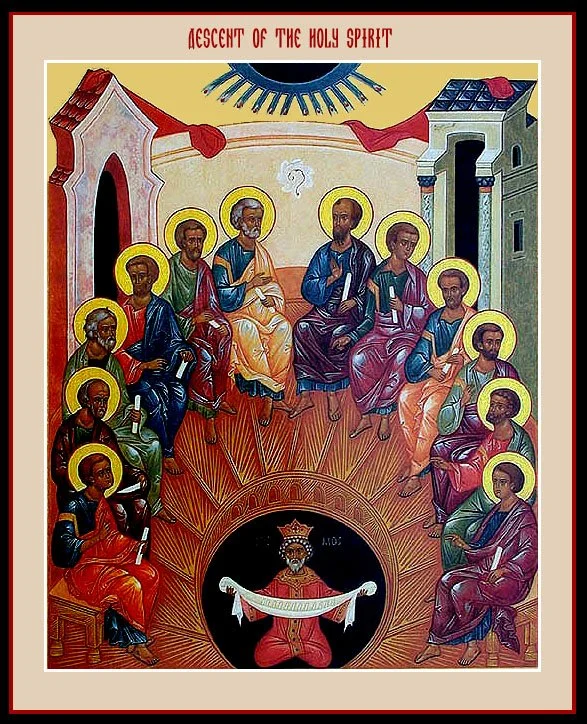
Sunday, May 31st, is the Eighth Sunday of Pascha and the day we celebrate Holy Pentecost, the Feast of the Holy Trinity. In the Church’s annual liturgical cycle, Pentecost is “the last and great day.” It is the celebration by the Church of the coming of the Holy Spirit as the end or fulfillment of the entire history of salvation. It is also the beginning: the “birthday” of the Church as the presence among us of the Holy Spirit, of the new life in Christ, of grace, knowledge, adoption to God and holiness.
This double meaning and double joy is revealed to us in the very name of the feast. Pentecost in Greek means fifty, which in the biblical symbolism of numbers means both the fulness of time and that which is beyond time: the Kingdom of God itself. With the descent of the Holy Spirit upon Christ’s disciples, the time of salvation, the Divine work of redemption has been completed, the fulness revealed, all gifts bestowed: it belongs to us now to “appropriate” these gifts, to be that which we are in Christ: participants and citizens of His Kingdom.
On this day, we also commemorate:
St. Apollonios (Apollo) of the Egyptian Thebaid (395)
Apostle Hermas of the Seventy (1st c.)
Martyr Hermias at Comana (2nd c.)
Martyr Philosophus at Alexandria (3rd c.)
Metropolitan Philotheos of Tobolsk, the Enlightener of Siberia (1727).
Readings for Sunday, May 31st:
-
1
When the Day of Pentecost had fully come, they were all with one accord in one place.
2
And suddenly there came a sound from heaven, as of a rushing mighty wind, and it filled the whole house where they were sitting.
3
Then there appeared to them divided tongues, as of fire, and one sat upon each of them.
4
And they were all filled with the Holy Spirit and began to speak with other tongues, as the Spirit gave them utterance.
5
And there were dwelling in Jerusalem Jews, devout men, from every nation under heaven.
6
And when this sound occurred, the multitude came together, and were confused, because everyone heard them speak in his own language.
7
Then they were all amazed and marveled, saying to one another, “Look, are not all these who speak Galileans?
8
And how is it that we hear, each in our own language in which we were born?
9
Parthians and Medes and Elamites, those dwelling in Mesopotamia, Judea and Cappadocia, Pontus and Asia,
10
Phrygia and Pamphylia, Egypt and the parts of Libya adjoining Cyrene, visitors from Rome, both Jews and proselytes,
11
Cretans and Arabs – we hear them speaking in our own tongues the wonderful works of God.”
-
37
On the last day, that great day of the feast, Jesus stood and cried out, saying, “If anyone thirsts, let him come to Me and drink.
38
He who believes in Me, as the Scripture has said, out of his heart will flow rivers of living water.”
39
But this He spoke concerning the Spirit, whom those believing in Him would receive; for the Holy Spirit was not yet given, because Jesus was not yet glorified.
40
Therefore many from the crowd, when they heard this saying, said, “Truly this is the Prophet.”
41
Others said, “This is the Christ.” But some said, “Will the Christ come out of Galilee?
42
Has not the Scripture said that the Christ comes from the seed of David and from the town of Bethlehem, where David was?”
43
So there was a division among the people because of Him.
44
Now some of them wanted to take Him, but no one laid hands on Him.
45
Then the officers came to the chief priests and Pharisees, who said to them, “Why have you not brought Him?”
46
The officers answered, “No man ever spoke like this Man!”
47
Then the Pharisees answered them, “Are you also deceived?
48
Have any of the rulers or the Pharisees believed in Him?
49
But this crowd that does not know the law is accursed.”
50
Nikodemos (he who came to Jesus by night, being one of them) said to them,
51
“Does our law judge a man before it hears him and knows what he is doing?”
52
They answered and said to him, “Are you also from Galilee? Search and look, for no prophet has arisen out of Galilee.”
12
Then Jesus spoke to them again, saying, “I am the light of the world. He who follows Me shall not walk in darkness, but have the light of life.”
The Holy Scriptures are part of the Church’s Holy Tradition. Metropolitan Kallistos Ware of blessed memory wrote:
In the words of Father Alexander Schmemann, “A Christian is the one who, wherever he looks, finds everywhere Christ, and rejoices in Him.” This is true in particular of the biblical Christian. Wherever he looks, on every page, he finds everywhere Christ.
See Metropolitan Ware’s article How to Read the Bible for more on an Orthodox approach to scripture.